
The Seizure Files · Forensic Evidence
If they take your phone, what is sitting inside it?
End-to-end encryption protects a message while it crosses the internet. It does nothing when your phone is in someone else's hands. Here is what published forensic research, court records and border statistics show — without hype or exaggeration.
1 · The forensic mechanism
Why "encrypted local database" does not stop an unlocked extraction.
Apps like Signal, WhatsApp, Session, Threema and SimpleX store your conversation history in a local SQLite or SQLCipher database on the phone. That database is encrypted — but the key that unlocks it is stored inside the same phone's OS Keystore so the app can open without asking you for a 64-character passphrase every time.
"The PIN lock does not offer additional encryption; it is simply a UI lock."
Cellebrite vs. Signal (Dec 2020)
When Cellebrite announced it could extract Signal messages, Signal founder Moxie Marlinspike pointed out the reality: Cellebrite hadn't broken Signal's cryptography — it simply read the local database from an already-unlocked phone. Once the phone is open, the local history is open.
Deleted app, recovered messages (2026)
In a documented 2026 federal investigation (Alvarado, TX), FBI examiners extracted incoming Signal messages from a seized phone's notification database in After-First-Unlock (AFU) state — even after the Signal app had been deleted and disappearing messages were enabled.
SQLite WAL & freelist remnants
Peer-reviewed mobile forensics research (Forensic Science International: Digital Investigation) demonstrates that standard forensic suites (Cellebrite Physical Analyzer, Magnet AXIOM, Oxygen) routinely recover local databases and deleted SQLite WAL/freelist records once a filesystem is accessible.
2 · Borders, biometrics & the $5 wrench
Why "just don't unlock your phone" fails in the real world.
Security advice often assumes you can politely refuse to unlock your device. In practice, three legal and physical realities make unlocked inspection the norm:
1. Compulsory biometric unlock
In United States v. Payne (9th Cir., 2024), the federal appeals court ruled that compelling a suspect to press their thumb or face to unlock a phone is a physical act, not testimonial, and does not violate the Fifth Amendment (while US v. Brown, D.C. Cir. 2025, created a circuit split). If Face ID or fingerprint is enabled, your phone can be unlocked in seconds.
2. Border checkpoints require no warrant
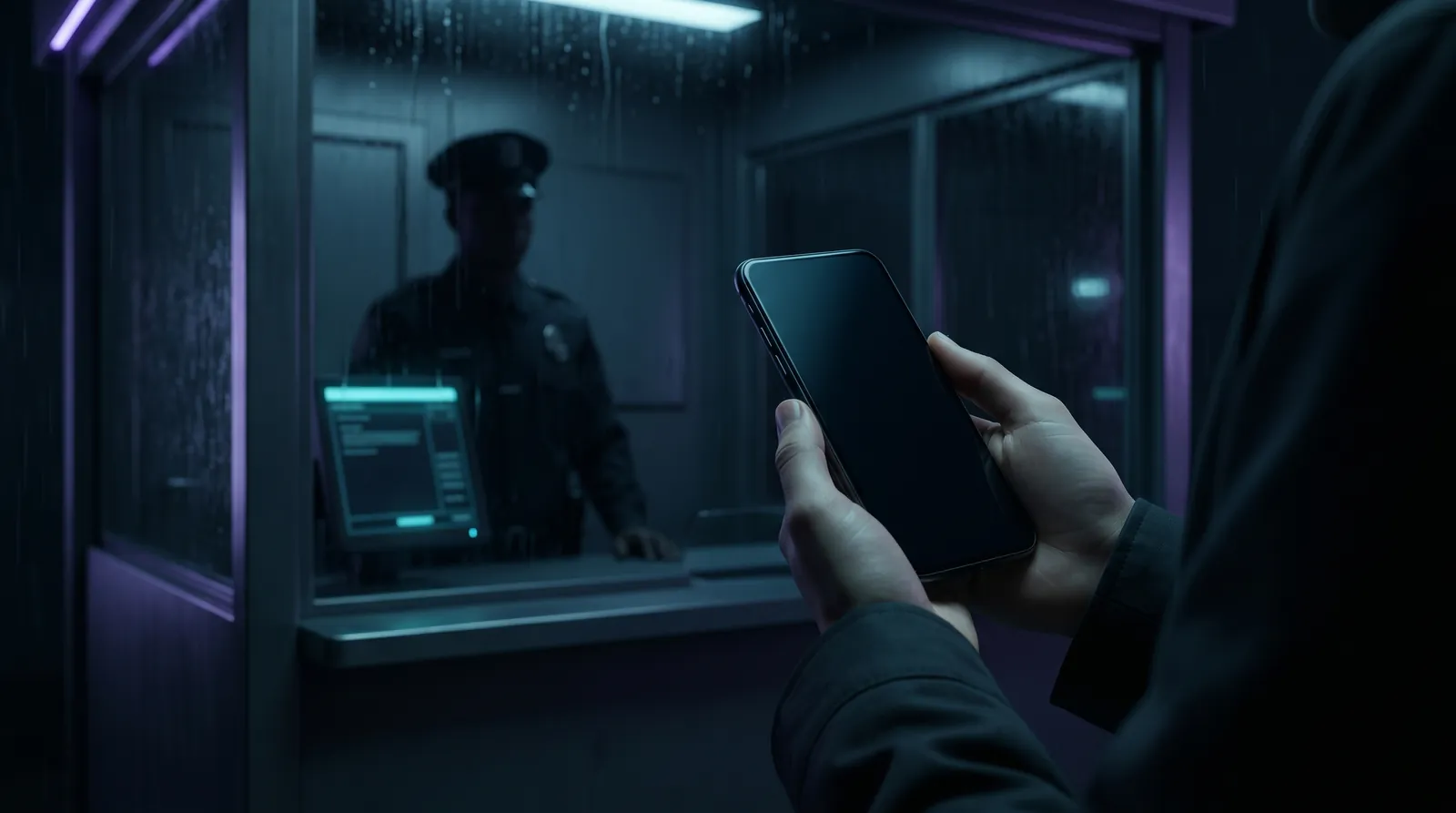
At international airports and land borders, customs officers do not need a warrant to demand a basic device inspection. Refusing to hand over an unlocked phone can result in immediate device confiscation for weeks, missed flights, or denial of entry for visa holders.
3. Physical coercion ("$5 wrench")
Whether it is an abusive partner demanding a phone, a street robbery targeting crypto holders, or detention in a hostile jurisdiction, under enough pressure everyone eventually gives up a code. An architecture that assumes superhuman resistance will fail the moment you are forced to type a PIN.
3 · Architectural defense
How zukka changes what happens when your phone is in someone else's hands.
Instead of promising a stronger lock on a local database, zukka removes the local database from the phone altogether — and gives you a realistic path when you are forced to hand over a PIN.
Nothing stored on the device
Messages, photos and contact lists are never written to your phone's storage. When the app closes, your phone holds zero chat history.
Split-key + Remote kill
Half of your key lives on our server, half on your phone. Destroy the server half remotely from another device and the phone can never decrypt anything again.
Unlimited PIN accounts
Different PINs open completely different accounts on the same login screen. Hand over the PIN to an ordinary account — nothing indicates that another account exists.
Panic password
Configure a dedicated panic password in advance. If typed at login under extreme duress, it destroys the account's data immediately, with no undo.
Honesty bar
Three things we will never exaggerate.
Keep nothing on your phone
Start a 30-day free trial on Android — no phone number, no email, and no card needed.